By Musa Igrek
In Tbilisi, exhibitions are closing. The organisations that funded them are shutting down. Artists are leaving. The dismantling of Georgia’s cultural life has come gradually, and it is not finished. Lali Pertenava watches it from the inside. A curator, researcher, founder of the Public Art Platform and board member of the International Association of Art Critics (AICA) Georgia, she spoke to Freemuse about what remains. Her work rests on the idea that art and civic life are inseparable. The word she reaches for, before any other, is “trapped”. She says it the way people say words they have been living with for a long time.
The trap, as she describes it, has a specific architecture. Since 2023, Georgian Dream – the ruling party founded by the oligarch Bidzina Ivanishvili, a French citizen who is widely understood to retain control over the Georgian state – has passed a succession of laws that have made independent civic and cultural life functionally impossible. A report submitted to the United Nations in December 2025 by Freemuse and AICA put Georgia’s artistic freedom crisis on the international record.
The laws that produced the crisis are worth naming. The “foreign agents law” has become the signature instrument of governments seeking to supress civil society while maintaining the appearance of legality. Georgia’s version, the Law on Transparency of Foreign Influence arrived in 2024 with the same intent. Known locally as the ‘Russian law’, it requires any organisation receiving more than twenty percent of its funding from abroad to register as pursuing the interests of a foreign power. A separate Foreign Agents Registration Act followed in 2025, adding criminal penalties of up to five years. There is also the Grants Law, amended repeatedly, which requires government approval before any foreign donor can issue a grant to a Georgian recipient. Non-compliance carries up to five years in prison. Human Rights Watch has called this a mechanism to curtail peaceful protests, independent media, and free speech.
Since we spoke with Pertenava, the trap has acquired new rooms. On 4 March 2026, the Grants Law was extended further – receiving unauthorised funding now carries up to six years in prison. New amendments extended criminal liability to anyone receiving foreign support for broadly defined political purposes. A new article in the criminal code went further still: “extremism against the constitutional order”, carrying up to three years for those who decline to recognise Georgian Dream as a legitimate authority. “As members of Georgia’s civil society”, Pertenava says, “we are punished and criminalised without cause”.
“Artists are only permitted to participate in pro-government activities or produce lovely, non-critical works.”
The consequences for the arts have been particularly acute, because the arts in Georgia had never been insulated against shock. Contemporary Georgian art developed not through state patronage but through a patchwork of international support: foreign agencies, diplomatic missions, local Civil Society Organisations (CSOs), the occasional residency programme. Artists were not eligible for social protection or professional tax advantages. Most relied on local CSOs or international funding, two streams that the new legislation have been, in Pertenava’s phrase, “eliminated”. The majority of independent organisations have shut down or suspended operations. Georgia’s independent cultural ecosystem, Pertenava says, has been largely extinguished.
There is an irony that Pertenava notes. In a country where the independent contemporary art world has been effectively legislated out of existence, the most popular, and state supported museum in the country is dedicated to Stalin, who was born in Georgia. The museum has been drawing visitors since 1957, more reliably, it turns out, than anything built since.
But the ironies of the situation are not her primary concern. What weighs on her more are: the people who have left, and the conditions facing those who have stayed. Most LGBTI+ artists, she says, have left the country, driven out by a combination of a new family values law that makes it problematic to publicly acknowledge their existence and a rate of community violence that makes life itself precarious. Actors, poets, and other artists have been prosecuted, or given criminal records, for expressing opinions at protests. The Georgian Orthodox Church, as Pertenava describes, has long been an instrument of cultural pressure – closing exhibitions and its affiliated groups disrupting events. Georgian Dream inherited that hostility and gave it the force of law. Those patterns continue.
For artists who remain, the options have been reduced to a stark binary. “In reality”, Pertenava says, “artists are only permitted to participate in pro-government activities or produce lovely, non-critical works”. State-funded theatres require government approval for their productions. Street groups affiliated with Georgian Dream disrupt or destroy individual artistic actions, an informal enforcement mechanism that operates alongside, and reinforces, the formal legal one. The atmosphere, she says, is one of pervasive intimidation.
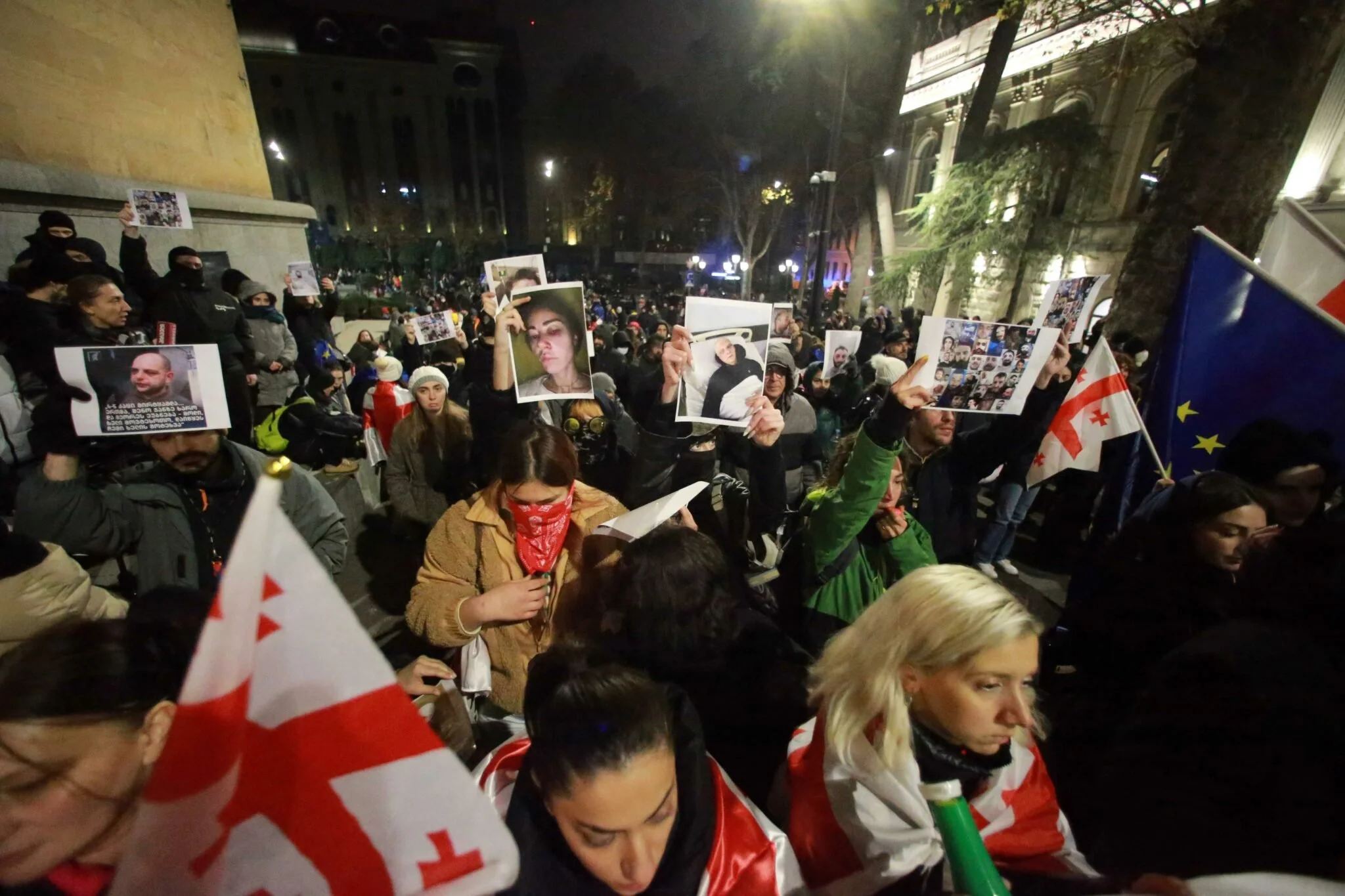
And yet, what continues, in the middle of all this, is music. Every Saturday, professors from the Tbilisi State Conservatory and professional musicians stage protest marches, playing drums and traditional Georgian instruments as they go. The music, Pertenava says, has become something new in the process. The experimental percussion of protest finding its way into the practice of classically trained musicians, producing what she calls a “potent symbiosis” between performance and the sounds of the street. One of the participating musicians told her that the experience had liberated her from the constraints of academic music, that her sense of what performance could be had expanded. Necessity, as it tends to do, has proven generative.
Anonymous acts of defiance appear and then vanish. Enormous banners bearing lines of poetry, “The people’s river will never end, flowing from the heart of homeland”, are hung in public places by cultural workers and artists, then quietly taken down. Civil society workers and artists have drawn together, Pertenava observes, in ways they had not before, speaking what she describes as the same language, finding that their concerns and their methods have converged. What is emerging, she believes, is a new kind of civil society, one shaped by crisis, and one that has learned to speak through art because it has had to. “These days”, she says, “ongoing, daily resistance is how artistic freedom is represented”. Not a condition one enjoys. Something one performs, under pressure, at cost.
“Ongoing, daily resistance is how artistic freedom is represented.”
Pertenava is grateful for expressions of international solidarity but realistic about what they are worth. Sanctions against Ivanishvili and key Georgian Dream figures should matter. Beyond that, practical support is not nothing: secure digital infrastructure for archiving cultural work that might otherwise be lost, international residencies, temporary placements for endangered voices. These are not symbolic gestures. In present conditions, she says, they are lifelines.
On 29 January, artists, cultural workers and activists gathered in Tbilisi to watch Georgia’s appearance before the UN Human Rights Council – the Universal Periodic Review, a process that brings every member state to account for its human rights record every four and a half years. Pertenava was in the room. The event was, organised as part of ongoing work between AICA Georgia and Freemuse, a room of Georgians watching their government’s delegation repeat what she describes as “obvious lies”.
A film manager in attendance called it the most boring artistic performance he had ever seen: three hours of nearly identical speeches from state legislators. Pertenava prefers to call it the most boring participatory performance. The audience, she says, erupted in spontaneous shouts whenever the delegation contradicted what everyone in the room knew to be true, and grew animated whenever a country delegation addressed Georgian Dream’s democratic regression directly. It was, in its way, a theatre of accountability – tedious, repetitive, and entirely unable to compel the outcome it documented. And yet, every Saturday, somewhere in Tbilisi, the drums go on.
This article was originally published by Freemuse.