This issue of AICA E-Mag brings together essays and reviews exploring how art and visual culture shape meaning, from colour and perception to identity, place, and power. Contributors move between historical foundations and urgent contemporary questions, offering fresh perspectives across exhibitions, books, and cultural debate.
In this issue:
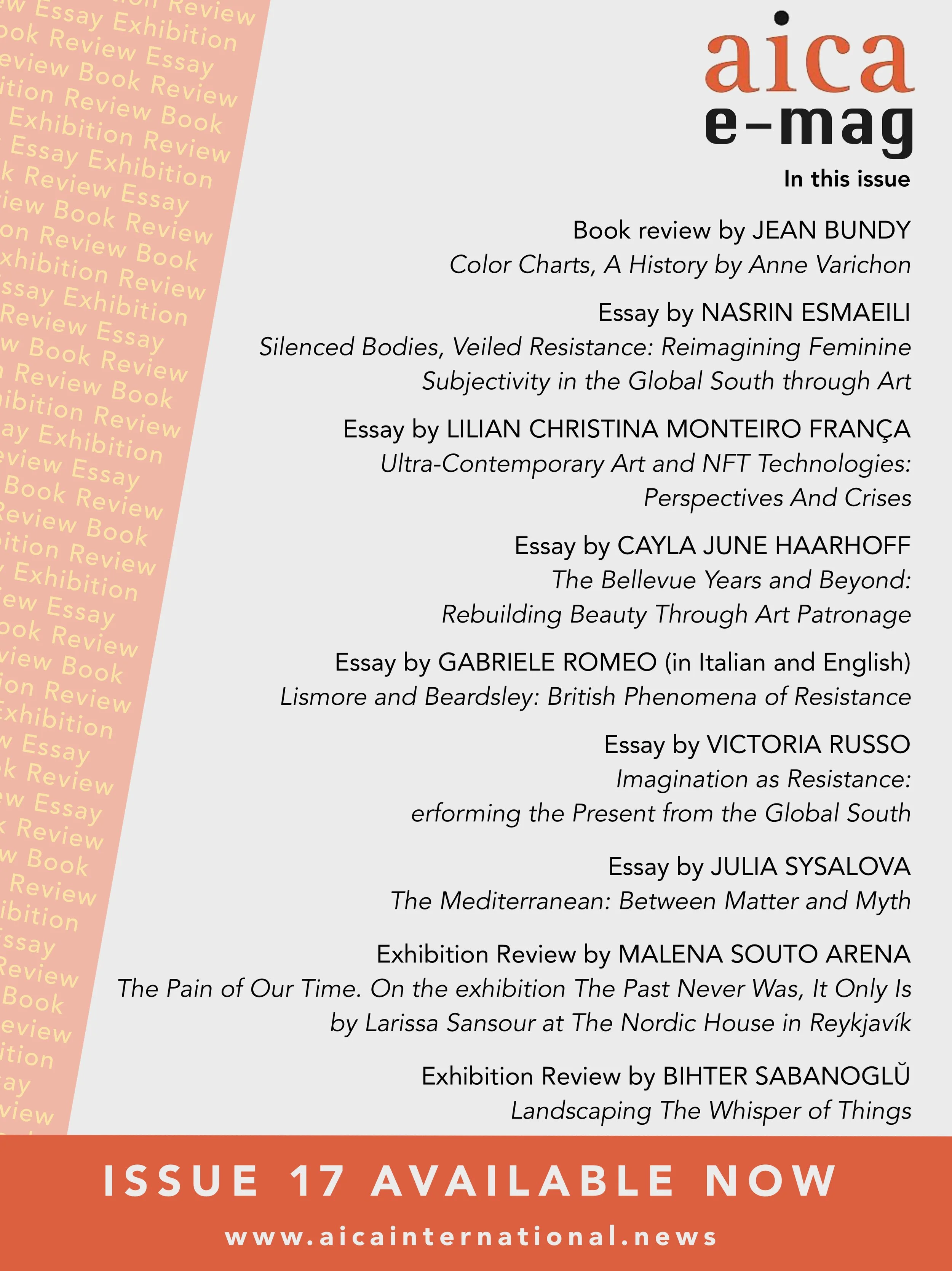
Jean Bundy’s book review, Color Charts, A History by Anne Varichon (trans. Kate Deimling) discusses the evolution and importance of color charts from the fifteenth century to the present, for manufacturing of paints, fabrics and cosmetics. In 1824, Michel-Eugѐne Chevreul (1786-1889) was appointed director of Gobelins Manufacture (organic & synthetic dyeing) and ‘systemized’ and ‘developed’ a scientific approach to color’ (41). Chevreul’s charts and theories are embedded into Modern art.
Nasrin Esmaeili’s essay recounts, “As a visual artist, researcher, and partially deaf Iranian woman, I have experienced how silence- both physical and symbolic- has shaped my life and work…. I explored how bodies that are often erased by rules, by culture, or by misunderstanding can still speak.”
Lilian Christina Monteiro França’s essay assesses, “The ultra-contemporary art segment….artists under 40…. is closely—though not exclusively—linked to the realm of NFTs ….The art market is being restructured, purportedly to be more democratic and inclusive, by seeking more independence and eliminating intermediaries.”
Cayla June Haarhoff’s essay interprets, “Madame de Pompadour …. [who] ceased her sexual relationship with King Louis XV… around 1750….was a strategic woman of intense social charm with grounded interests in the Enlightenment and resounding political capabilities.”
Gabriele Romeo’s essays explain, “Fashion has acquired a…language rich with meanings, capable of embodying political and cultural ideas…. Daniele Lismore and Aubrey Beardsley perfectly embody this idea, as, despite operating in different eras, they use the body and symbolism to challenge social and political conventions.”
Victoria Russo’s essay elaborates, “Far from being a conventional publication, IMAGINACIÓN is a living, unfolding body of work....While rooted in the Argentine context, IMAGINACIÓN resonates with global movements facing authoritarianism, ecological collapse, and identity-based violence.”
Julia Sysalova’s essay suggests, “The Mediterranean ceases to be an image of paradise [Mediterranean is tourism] and becomes instead a site of critical experience…where ancient symbols coexist with contemporary catastrophes:….the climate crisis, migration routes, postcolonial traumas, energy conflicts, and the crisis of European identity….The artist takes on the role of a figurative archaeologist.”
Malena Souto Arena’s exhibition review critiques The Past Never Was, It Only Is by Larissa Sansour (Nordic House, Reykjavik in 2025) which explains how the show “enacts a political confrontation with social trauma, grief, and speculative futures, offering a reflection on the political devices through which memory is erased, mutated, and transmitted.”
Bihter Sabanoglŭ’s exhibition review of Landscaping The Whisper of Things (Sanatorium, Istanbul thru 1/10/26) references W.J.T. Mitchell’s, Landscape and Power, while posing that the show “questions concepts of scale, progress, and perception, transforming the exhibition space into a landscape in the posthuman sense: one of hidden relational networks that reveal the entangled nature of humans and nonhumans, decentralizing, or rather, de-anthropocentrizing knowledge.”